Symptom triage · Not cooling
My Sub-Zero stopped cooling — what's wrong?
Start by naming which compartment is warm, because on a Sub-Zero built-in that single fact splits the problem in half. If the fresh-food side drifts warm while the freezer holds, you're usually looking at a fan or defrost fault on one circuit. If both compartments warm together, that raises sealed-system suspicion that needs EPA-certified verification — but first we rule out a choked condenser, the cheaper and far more common cause in Alameda and neighboring San Leandro, where salt air and fog cycles foul coils early. Tell us which symptom matches and we'll line up the likely part before the truck rolls.
Why is my Sub-Zero not cooling in Alameda?
Alameda Sub-Zero Repair first names which side is warm: a fresh-food compartment drifting past its near-38°F target while the freezer holds near 0°F usually means a stalled fan or a condenser choked of airflow, not a dead unit. We serve the Gold Coast and the 94501 core; call (510) 390-9712.
How "not cooling" actually shows up
Most owners don't catch a Sub-Zero the moment it quits. You notice softening ice cream, condensation on jars, butter that won't firm, or a unit that runs constantly and feels warm at the base grille. The first useful step is to read the actual numbers: a fresh-food compartment should hold near 38°F and a freezer near 0°F. A few degrees of drift after a long door-open session or a big grocery load is normal and recovers within an hour. A compartment that climbs past 45°F and stays there, or a unit that runs nonstop without pulling temperature down, is a fault, not a setting.
Pay attention to the pattern over a day. A unit that recovers overnight but warms under daytime load is telling you something different from one that simply never gets cold. Note whether the compressor runs at all, whether you hear airflow inside, and whether the base grille is hot — those three observations often separate a fan or airflow problem from a sealed-system one before anyone opens a panel.
Move the food and unplug if you smell heat
If the fresh-food compartment is above roughly 45°F, relocate perishables and stop trusting the box. A still-cold freezer can stay closed to buy hours, but if you smell anything hot, acrid, or electrical near the base grille, unplug the unit and call. Pushing a struggling system harder is how a recoverable fan or condenser fix turns into an expensive sealed-system repair.
Likely causes, simple to expensive
This is the order a diagnosis moves through — cheapest and most common first. The "test" column is what separates a clean repair from an unnecessary one.
| Likely cause | Signs you'd see | How we test it | Typical repair |
|---|---|---|---|
| Condenser coil fouled with dust or pet hair | Both sides slowly warming, runs hot and nonstop, grille area warm | Visual condenser inspection + airflow check at the base grille | Often a clean, no part needed |
| Stalled or weak evaporator fan | Fresh-food warm, freezer holds; little or no airflow heard inside | Fan operation check + compartment temperature log | Evaporator fan motor |
| Defrost system fault (heater / thermostat / sensor) | Gradual warming with frost buildup blocking the evaporator | Defrost cycle check + sensor resistance reading | Defrost heater, sensor, or board |
| Door gasket leak letting humid air in | Sweating door, frost line, unit running long to keep up | Seal compression check around the full perimeter | Magnetic gasket in correct profile |
| Thermistor or control-board fault | Temps wrong while parts seem to run; panel reads off | Service-mode read + independent probe trace | Thermistor, then board if proven |
| Sealed-system / compressor loss | Both compartments warm, compressor runs but no cooling, coil already clear | EPA-certified leak & pressure test | Sealed-system repair (priced separately) |
Working top-down matters most on the warm-both-sides complaint. A condenser coil packed with dust or pet hair mimics a dying compressor — same nonstop running, same slow warm-up — but costs a fraction to fix. We won't quote sealed-system work until that coil is verified clean and an EPA-certified leak and pressure test actually shows a loss. Jumping straight to refrigerant on a hunch is how a cheap visit becomes a four-figure one.
Why Alameda kitchens see this sooner
In the 94501 core — the Gold Coast, the East End, the blocks behind Park Street — built-ins are often set into original millwork with barely any clearance. Tight surrounds choke a condenser's airflow on a good day, so the marine grit and fog-cycle humidity drifting through these old kitchens collect on the coil faster than in a newer, open build. Add the age of the housing stock, water lines snaked through retrofit cabinetry, and a refrigerator-plus-wine-column appliance mix, and units run a little warm for months before the owner notices a real no-cool day. The access path is half the job: easing a flagship unit out past period casework without scratching it takes time we plan for, not force.
Out on Bay Farm Island and the newer 94502 builds, the cabinetry is friendlier but the open, humid air off the water is hard on gaskets and condenser surfaces — so the same not-cooling symptom skews toward seal leaks and corrosion rather than tight-clearance fouling. None of this means a unit is failing; the marine climate just pushes the wear into predictable places, which is where we look first. What it can't tell us in advance is whether a coil clean will fully restore temperature or whether months of overwork already strained the sealed system. That answer only comes from on-site readings.
When the unit has to come out to find the fault
Some not-cooling faults — a condenser that needs deep cleaning, a rear evaporator fan, or any sealed-system access — mean the built-in has to be carefully eased out of its cabinet and reseated afterward. In plain terms, that's the "built-in cabinet removal and reseat" risk: a Sub-Zero is heavy, the surround is often custom millwork, and the unit rides on glides and brackets that have to be released in the right order so nothing racks or scratches. Done carelessly, a pull can chip a panel, kink a water line, or knock the door out of alignment so the gasket no longer seals — a brand-new cooling complaint.
What confirms the pull is needed is the on-site diagnosis: if temperature readings, the fan check, and the condenser inspection point to a component only reachable from the back, we say so before we move anything. The honest limitation is that we can't always know in advance whether a tight Gold Coast install will reseat perfectly — older shims and settled cabinetry sometimes shift. We flag that up front rather than discover it mid-job.
What the diagnosis looks like, documented
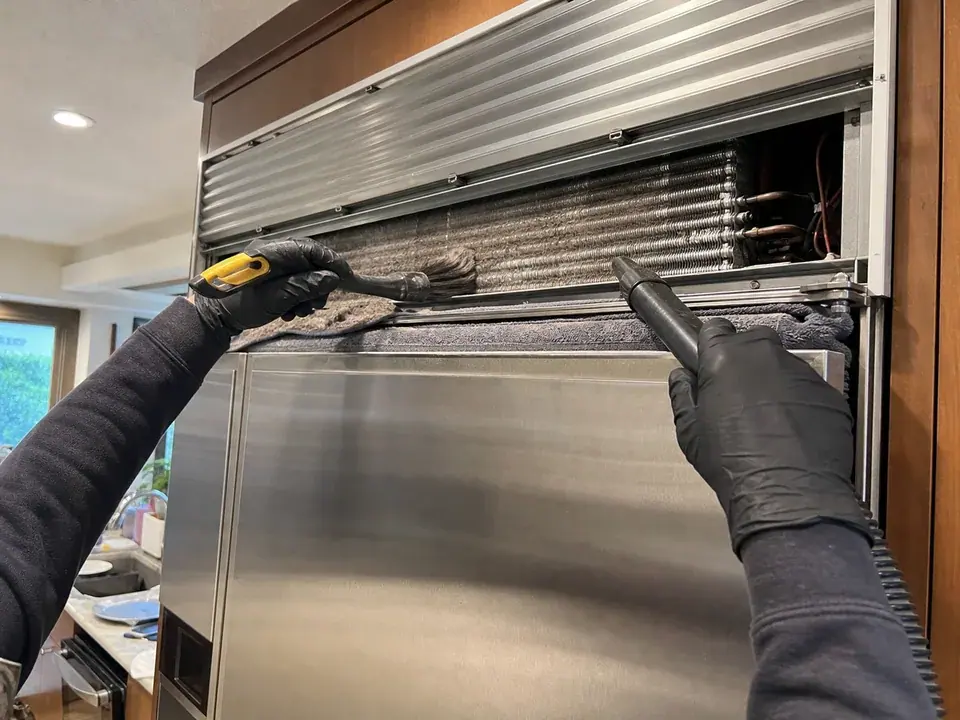
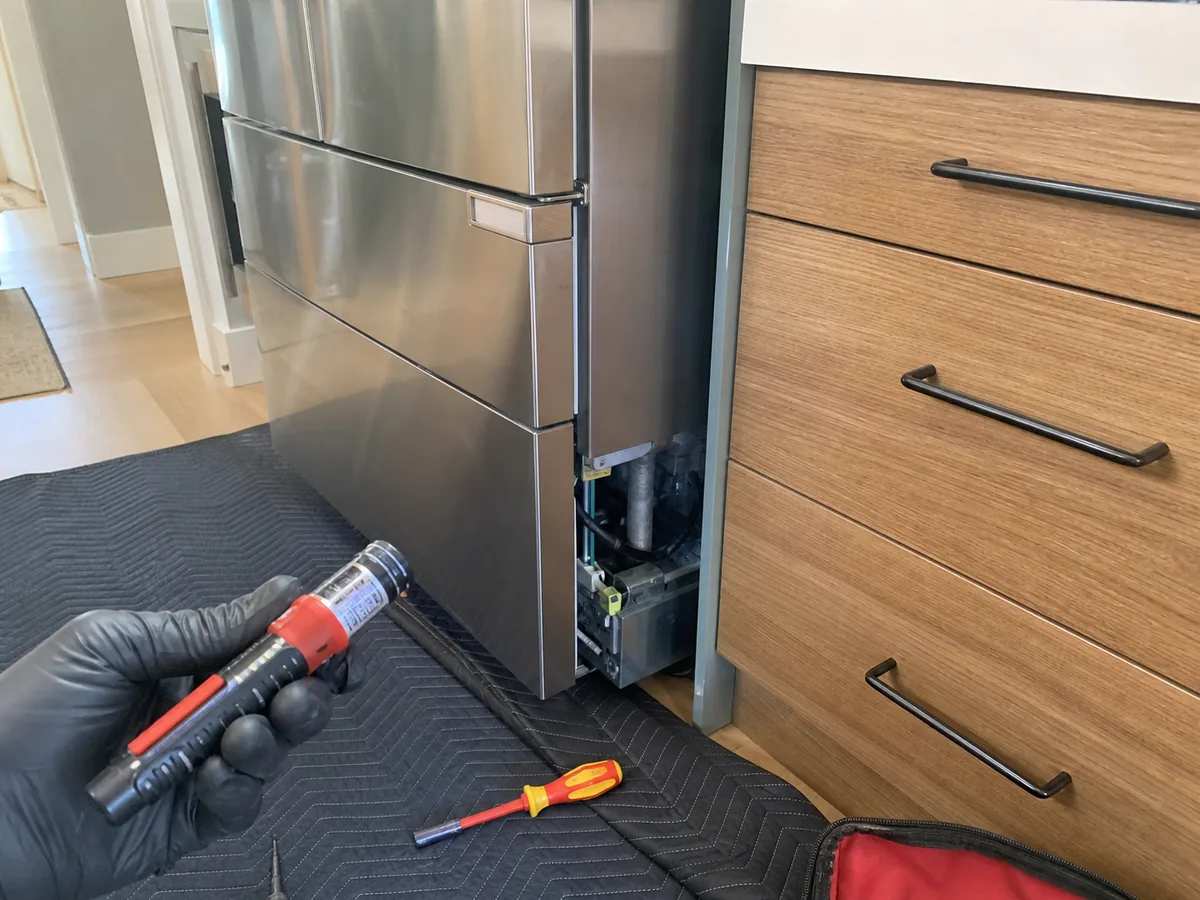
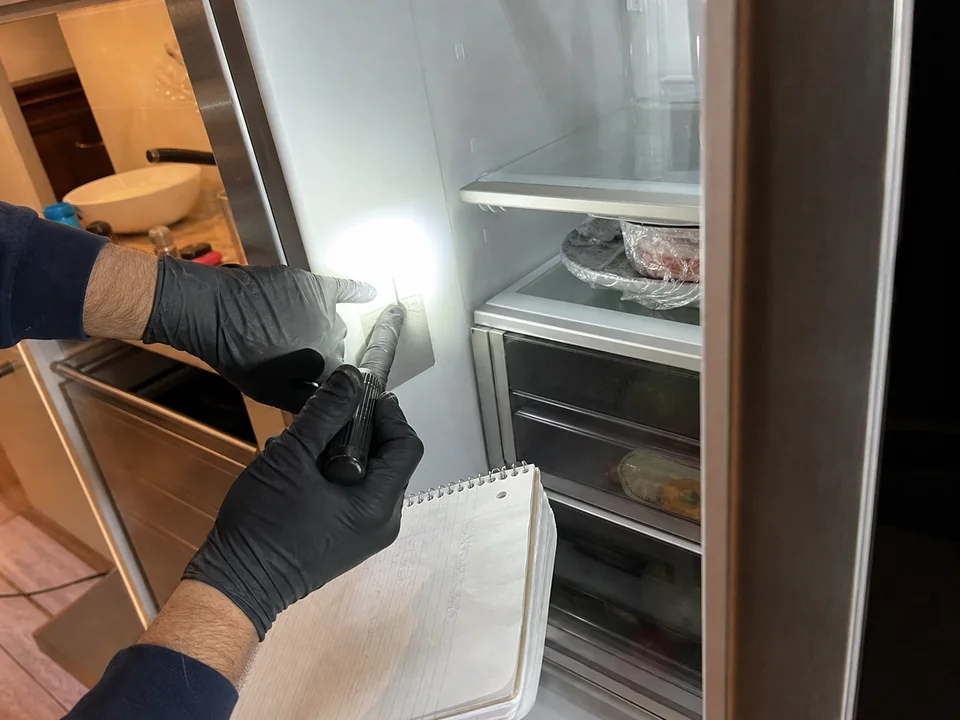
A not-cooling call leaves a paper trail, not just an opinion. The close-up below is the most common warm-both-sides culprit; the wider shot is reserved for the real unit in your kitchen so the file matches the repair.
Know which side is warm? Let's line up the part.
Tell us the symptom — fresh-food warm, freezer warm, or both — and send a photo of the rating plate. We'll confirm whether the likely fan, gasket, or board is in stock for an Alameda visit before you commit to a time.
Diagnose a Sub-Zero that isn't cooling — 7 steps
Before you call, these checks separate an easy airflow fix from a sealed-system fault. A Sub-Zero holds the fresh-food compartment near 38°F and the freezer near 0°F; none of these steps open the sealed system.
Read both compartment temperatures
Put a thermometer in each compartment for 10 minutes. Fresh-food near 38°F and freezer near 0°F is normal; note which side is off.
Decide which side is warm
A warm fresh-food side with a cold freezer points to one sealed system or a fan; both sides warming raises a condenser or sealed-system question.
Inspect the condenser coil
On built-ins the grille is up top. A coil matted with dust or pet hair chokes airflow — a frequent Alameda cause, worse on salt-air blocks.
Listen for the evaporator fan
With the door switch held, a silent or rattling fan behind the rear panel can be the whole fault on the warm side.
Check for heavy frost or ice
A thick frost slab on the evaporator suggests a defrost fault rather than a refrigerant loss.
Move perishables if it's above 45°F
If the fresh-food side is above about 45°F, move food and stop relying on it to avoid turning a fan fix into a sealed-system repair.
Photograph the rating plate and any alarm
Send the model, serial, and any service code so the right factory-authorized OEM part rides on the van.
What a not-cooling fix tends to run in Alameda
The spread is wide on purpose: this symptom can resolve with a condenser clean and no part at all, or land at a sealed-system repair on a built-in — which is why we test before we quote. The table lists typical Alameda estimates; your real number is set on site once the model and serial are confirmed.
| Service / symptom | What's included | Price range | Timeframe |
|---|---|---|---|
| Diagnostic / service call | On-site measured diagnosis, model & serial confirmed, written findings (credited) | $115–$185 | Same visit |
| Condenser clean / airflow restore | Coil cleaned and airflow restored, temperature recovery verified | $145–$285 | 1 visit |
| Evaporator fan motor | factory-authorized OEM evaporator fan motor, airflow and recovery confirmed | $345–$645 | 1 visit |
| Defrost heater / sensor / timer | Defrost circuit diagnosed and failed component replaced | $290–$565 | 1 visit |
| Thermistor / temperature sensor | Sensor replaced, verified against a logged probe trace | $185–$345 | 1 visit |
| Control board (generation-matched) | Board matched to your generation, service-mode reset | $485–$845 | 2–6 days (part order) |
| Sealed system / compressor (EPA) | Leak/charge or compressor with refrigerant recovery and recovery check | $1,750–$3,450 | 1–2 visits |
Typical Alameda estimates, not a quote.
What determines the final price: whether the fix is a no-part condenser clean or a sealed-system repair, the tightness of the built-in pull, and your unit's generation. For the keep-or-replace math when the estimate climbs, see repair vs. replace.
Not-cooling questions
My Sub-Zero freezer is fine but the fridge is warm — what does that mean?
On a built-in, two independent sealed systems share the cabinet, so the fresh-food side can warm while the freezer holds. That usually points to a stalled evaporator fan, a defrost fault, or a single circuit underperforming — not a dead refrigerator. We confirm with compartment temperatures and a fan check before naming a part. The main Sub-Zero repair page covers the full family of faults.
Both compartments are warm — is the compressor dead?
Not necessarily. Both sides warming raises sealed-system suspicion, but the first thing we rule out is a condenser coil packed with dust or pet hair that has choked airflow and overheated the system. If the coil is clear, an EPA-certified leak and pressure test confirms whether refrigerant or the compressor is actually the issue — we never top off on a hunch. See the sealed system & compressor page for that path.
Should I keep using my Sub-Zero while it warms up?
If the fresh-food compartment is above about 45°F, move perishable food and stop relying on it. You can keep a still-cold freezer closed to buy time, but if you smell anything hot or electrical, unplug the unit and call. Running a unit hard while it struggles can turn a fan or condenser fix into a sealed-system repair.
Why does my Sub-Zero seem to cool worse in summer fog season?
Alameda's marine humidity loads the cabinet with moisture and ages door gaskets, while salt-laden air corrodes condenser surfaces. A coil that is already grit-fouled struggles harder on warm, humid days, so a marginal unit tips into a no-cool complaint exactly when fog cycles raise the indoor load. The fault was usually building for months.
How much does it cost to fix a Sub-Zero that isn't cooling in Alameda?
It ranges widely because the symptom does. A condenser clean is $145–$285 and a stalled evaporator fan is $345–$645, while a sealed-system or compressor repair is $1,750–$3,450 — plus a $115–$185 diagnostic credited to the work. We test before we quote, so a warm fridge that just needs airflow restored never gets billed as a sealed-system job.
What temperature should a Sub-Zero hold, and when should I stop using it?
A Sub-Zero holds the fresh-food compartment near 38°F and the freezer near 0°F. If the fresh-food side climbs above about 45°F, move perishables and stop relying on it. A still-cold freezer can stay closed to buy time, but running a struggling unit hard can turn a fan or condenser fix into a sealed-system repair.
Back to the full Sub-Zero repair page → See repair-vs-replace pricing →
Alameda · Sub-Zero owners
What Alameda customers say
Fridge warm, freezer perfectly fine — I assumed the worst. They explained how the two sealed systems work, found a single stalled evaporator fan on the fresh-food circuit, and it cost a fraction of the new column I'd been pricing.
They measured airflow and both compartment temperatures instead of guessing at a part. The condenser was choked with dust and grit, so they cleaned it, replaced one tired fan motor, and verified the fresh-food side recovered to spec before leaving.
A same-day visit when our food was at risk with the fresh-food side climbing past 50. They were honest about what they could confirm on site, traced it to a defrost fault rather than the compressor, and had it holding temperature by evening.
Keep reading · Alameda
More from the Alameda service file
Same-day visits when food is on the line
A warm fresh-food side over a loaded refrigerator doesn't belong in next week's schedule — how urgent slots are triaged across the Island.
Error codes & alarms, read safely
If a display alarm came with the warm-up, here's what each alarm actually points to — and why the board is rarely the culprit.
The Alameda Sub-Zero repair FAQ
Diagnostic credits, parts sourcing, scheduling windows — the questions owners ask before booking, answered in one place.
The full scope of Sub-Zero repair work we handle in Alameda
Not-cooling is one symptom of many. Gaskets, ice, sealed systems, and controls — the whole service, one page.
Water pooling as well as warming up?
If you are also finding water under the unit or in the freezer, a defrost-drain or condensate fault is in play — trace where the water is coming from.
What a not-cooling repair costs in Alameda
From an airflow clean to a sealed-system job — the honest price bands by fault, with the $89 diagnostic credited to the work.