Symptom · Ice & water path
Sub-Zero ice maker slow, jammed, or making hollow cubes in Alameda
When a Sub-Zero in an Alameda kitchen drops thin, hollow, or cloudy ice — or quietly stops keeping the bin full — the trouble is almost never the ice module itself. It is the water path feeding it: the inlet valve, the filter, or the fill tube. In the Island's older Victorians, that line often runs through tight cabinetry where marine humidity and fog cycles can refreeze the tube. It is the same precision a wine column drifting several degrees demands — measure first. We log a fill-volume test before naming a part. Send the symptom and a model-tag photo, or call below — the proof comes before the quote.
How do you fix a slow Sub-Zero ice maker in Alameda?
Alameda Sub-Zero Repair runs a logged fill-volume test through one harvest, which isolates whether the inlet valve, filter, or a frozen fill tube is starving the mold before any part is named. We cover Park Street and the 94501 core; call (510) 390-9712 and read us the symptom and model tag.
The short answer
Why is my Sub-Zero ice maker not making ice?
For ice to form, the freezer must hold at or below roughly 0–5°F and water must reach the mold; the common faults are a failing water inlet valve, a clogged filter, or a kinked fill line — not the ice module, which we treat as the last suspect on Alameda's soft EBMUD water.
Confirm the freezer temperature
Check that the freezer side is holding near 0°F; a compartment drifting above ~5°F won't harvest properly and points to a cooling fault, not the water path.
Replace a filter past its season
A water filter older than about six months is the most common restriction on Alameda's soft water — swap it first and watch whether fill recovers.
Check the supply shutoff
Find the saddle or shutoff valve under the sink or behind the unit and make sure it is open all the way.
Look for a frozen or kinked fill tube
Estuary fog and marine humidity can refreeze moisture at the fill tube; a visible ice plug there starves the mold.
Watch for a buzzing or weak inlet valve
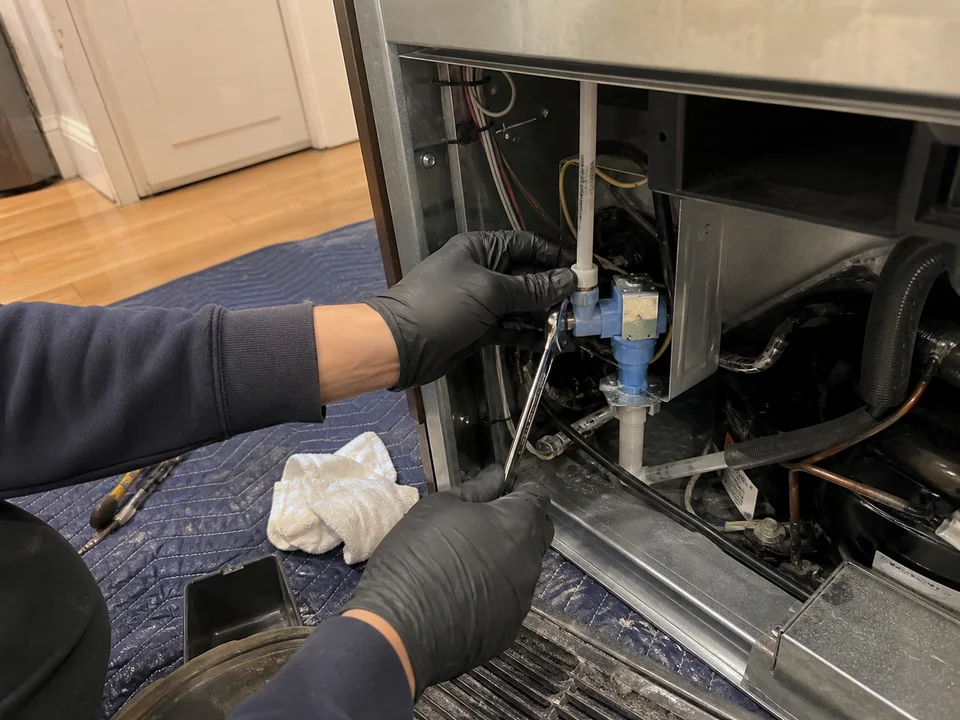
A valve that hums but barely fills, or won't open fully, leaves hollow cubes — we confirm it with a logged fill-volume and a coil reading.
Don't force a jammed ejector arm
If cubes jam, stop the maker and never chip ice with metal; forcing the arm can crack the mold or strain the harvest motor.
Photograph the rating plate
The serial fixes which inlet valve, filter and module your generation uses, so the right factory-authorized OEM part rides on the van to Bay Farm Island or the East End.
How the trouble first shows up
Most owners notice it at the dispenser before they notice it in the bin. Cubes come out thin and hollow, or with a milky cloud through the middle; production slows until the bin never quite refills; or the maker jams and the ejector arm stops mid-cycle. A healthy Sub-Zero maker drops clear, full, solid cubes on a steady harvest, refilling a normal bin within a day. Slow, hollow, cloudy, or shrinking cubes are the abnormal signal — and they nearly always point to the water reaching the mold, not the mold itself.
There is also a quieter version of the same fault. A separate alarm or temperature warning on the panel can ride alongside an ice problem — what owners loosely call a "control board, thermistor, or display alarm." In plain language, the thermistor is the temperature sensor, the control board is the small computer that acts on it, and the display alarm is what surfaces when a reading falls outside its expected window. Diagnosis confirms which one is real by reading the sensor's resistance against spec in service mode and comparing it to an independent probe — if the sensor reads true but the board still alarms, the board is implicated; if the sensor reads off, it is the sensor. The honest limitation: we cannot tell from the alarm code alone whether an intermittent board fault is the cause or a symptom of a starved, icing fill line nearby. That takes a live measurement on site.
If cubes are jamming, stop the maker
Stop dispensing and don't force the ejector arm or chip jammed ice with anything metal — that strains the harvest motor and can crack the mold. If water is pooling under the unit or the supply line is wet, close the shutoff and leave it. A jam is usually a fill or melt-and-refreeze problem upstream, and forcing it only adds a second repair to the first.
Likely causes, simple to expensive
This is the order we actually work the water path — cheapest, most common restriction first, the module itself last. The "test" column is what separates a quick filter swap from a valve replacement; the symptom you see rarely names the part on its own.
| Likely cause | Signs you'd notice | How we test it | Typical repair |
|---|---|---|---|
| Spent water filter | Cloudy or shrinking cubes, slower fill, off taste | Filter age check + fill-volume before/after | OEM filter, flush the line |
| Kinked or frozen fill tube | Hollow cubes, partial harvests, ice at the tube | Visual trace + thaw-and-refill observation | Reroute or clear the tube; correct the freeze point |
| Closed or weak supply / shutoff | Maker runs but barely fills | Static and flowing pressure at the line | Open or service the shutoff; clear the saddle valve |
| Tired water inlet valve | Slow fill, hollow cubes, valve buzzes or won't open fully | Logged fill-volume + electrical read on the coil | factory-authorized OEM inlet valve, serial-matched |
| Ejector / harvest motor or module | Cubes form but won't release; arm stalls mid-cycle | Cycle observation after the water path is cleared | Module or motor — only once fill is proven good |
The pattern holds across the lineup we see most: undercounter UC/UR ice makers, the in-door makers on built-in BI units, and standalone ice units — all made by Sub-Zero Group, Inc. We do not replace the module on a hunch; it is the last row for a reason.
Why Alameda water and air change the read
The marine climate does specific things to an ice maker. Fog cycles and steady humidity load the cabinet and the area around the fill tube with moisture, and on units set into tight waterfront cabinetry — common in the East End's 1920s bungalows where the water line snakes through retrofit casework — that moisture can refreeze at the tube and choke the fill. Salt air and the gasket swelling it causes let a little more humid air past the door, which adds to the frost load right where the ice path lives. None of that means the maker has failed; it means the restriction shows up sooner here, and in predictable places.
Service across the estuary in Oakland shows the real impact of these factors together. A Sub-Zero behind a paneled Rockridge built-in might share a single saddle valve with a pot-filler, so a pressure drop there reads at the ice maker first; a tight Temescal kitchen makes the cabinet pull half the job before any test can run; and the older homes there mix a 1990s built-in with newer plumbing, so the part revision and the fitting on the supply line rarely match the assumption. Access, climate, home age, routing, cabinetry, and the appliance mix all move the diagnosis — which is why we read the actual line instead of a generic chart. The same logged-pressure discipline travels south to San Leandro, where newer tract kitchens hide the supply behind finished panels that have to come off carefully before a flow reading means anything.
What we measure and document
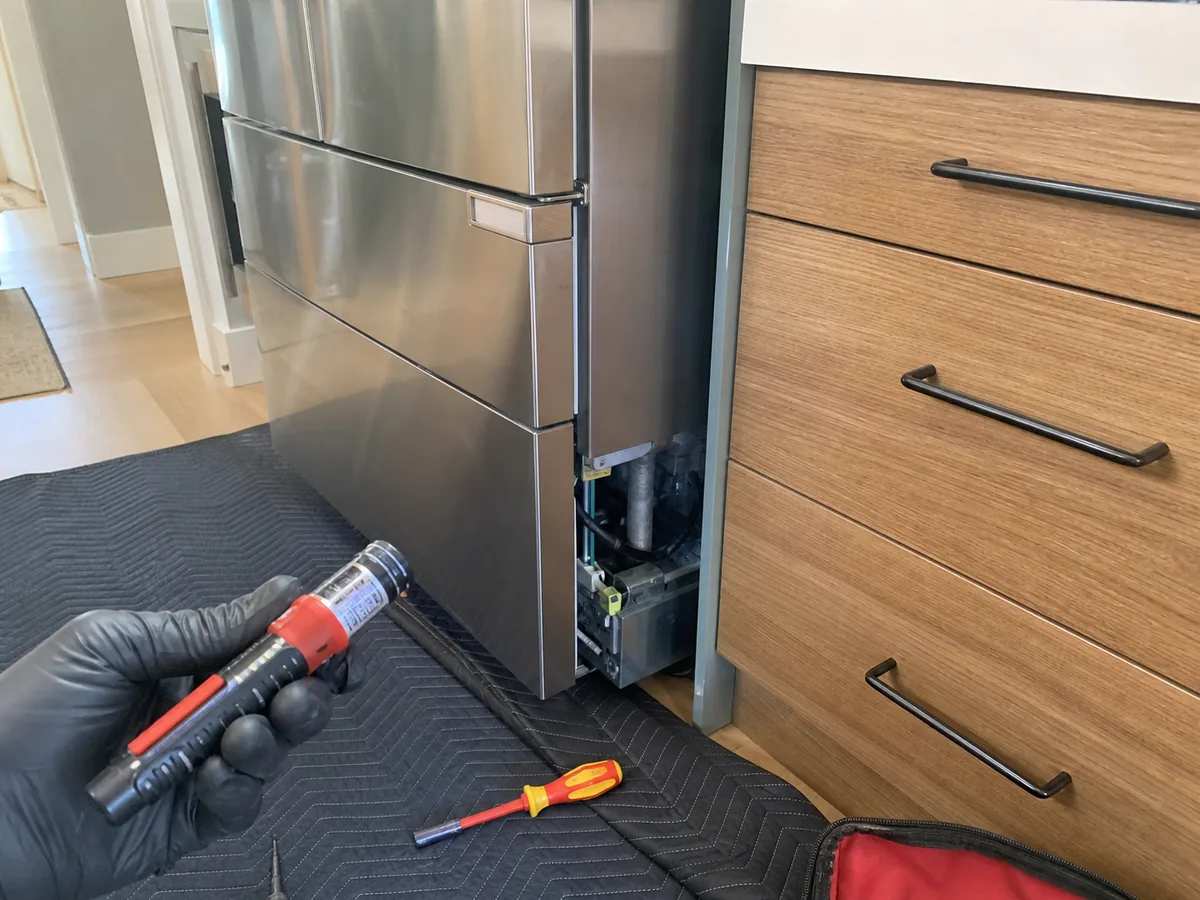
A fill-volume test is the spine of this diagnosis: we run a harvest, catch and measure the water the valve actually delivers, and compare it to what the mold needs for a full, solid cube. That single number tells us whether the inlet valve, filter, or fill tube is the restriction before any part is opened. It also keeps us honest about the related faults — a fresh-food section warm while the freezer still holds, or a wine zone drifting off setpoint — because we read each on its own evidence rather than guessing from one symptom.
When that warm-fresh-food pattern rides alongside an ice complaint, the evidence we collect is concrete: temperature readings logged over a cycle, condenser and evaporator photos, model-tag proof to fix the exact part revision, and factory-authorized OEM fan, gasket, or control-board evidence where the fault reaches past the water path. The repair is backed by what we measured, not a sales pitch.
Check slow or hollow Sub-Zero ice before a visit
Most ice faults trace to the water path, not the ice maker itself. These five checks help you — and us — find the restriction before a technician arrives.
Note the cube fault
Hollow cubes mean the mold is starved of water; cloudy or shrinking cubes point to an old filter or sediment. The pattern tells us where to look.
Check the filter age
If the water filter is past about six months, replace it first — a clogged filter is the most common cause of slow Sub-Zero ice on Alameda's soft water.
Look for a frozen or kinked fill tube
Marine humidity can refreeze moisture around the fill tube; a visible ice plug at the tube starves the mold.
Confirm the supply shutoff is fully open
Find the saddle or shutoff valve under the sink or behind the unit and make sure it is open all the way.
Photograph the rating plate
The serial fixes which inlet valve, filter, and module your generation uses, so the right factory-authorized OEM part rides on the van.
What a Sub-Zero ice or water-line repair tends to run in Alameda
Most ice-path fixes are modest — a filter, a fill-tube clearance, an inlet valve. The table lists typical Alameda estimates; your real number is set on site after a logged fill-volume test names the actual restriction.
| Service / symptom | What's included | Price range | Timeframe |
|---|---|---|---|
| Diagnostic / service call | On-site fill-volume test, model & serial confirmed, written findings (credited) | $115–$185 | Same visit |
| OEM water filter + line flush | Genuine filter, supply line flushed and checked | $125–$215 | 1 visit |
| Fill-tube clearance / reroute | Frozen or kinked fill tube cleared or rerouted | $175–$340 | 1 visit |
| Water inlet valve (serial-matched) | factory-authorized OEM inlet valve, fill volume re-verified | $245–$525 | 1 visit |
| Shutoff / supply-line repair | Saddle or shutoff valve, or buried supply line in finished casework | $195–$420 | 1 visit |
| Ice module / harvest motor | Module or harvest motor, fitted only after the water path is cleared | $320–$660 | 1–2 visits |
Typical Alameda estimates, not a quote.
What determines the final price: the cabinet pull, whether the supply line is shared or buried in finished casework, and whether the fault is one restriction or several stacked together. The ice module is usually the last suspect, not the first.
Read me the symptom and the model tag
Tell us what the ice is doing — slow, hollow, cloudy, or jamming — and send a photo of the rating plate. We'll know which valve, filter, or tube your generation uses and confirm the part before an Alameda visit. Calling is the fastest way to reach us.
Ice maker & water-line questions
Why are my Sub-Zero ice cubes hollow or cloudy?
Hollow cubes usually mean the mold is being starved of water — the fill stops before the cavity is full, so the cube freezes around an empty core. Cloudy cubes point the other way, toward a tired filter or sediment in the supply. A logged fill-volume test tells us which it is before we touch the inlet valve or filter. The same measure-first approach runs through the full Sub-Zero repair page.
My Sub-Zero ice maker is slow or only makes a few cubes a day — is the module dead?
Rarely. Slow production almost always traces to a restriction in the water path — a partly clogged filter, a kinked or frozen fill tube, or an inlet valve that no longer opens fully. The ice module itself is usually the last suspect, not the first, which is why we measure fill volume before naming a part.
Should I keep using the ice maker if cubes are jamming?
Stop dispensing and don't force the ejector arm or chip jammed ice with anything metal. A jam often means a fill or melt-and-refreeze problem upstream, and forcing the arm can strain the motor or crack the mold. Leave it and let us read the water path. If you're weighing the cost against the unit's age, the repair vs. replace page lays out the pricing math.
Does Alameda's water or marine air affect the ice maker?
Indirectly. Marine humidity and fog cycles load the cabinet with moisture that can refreeze around the fill tube, and local water mineral content shortens filter life, which shows up first as cloudy or shrinking cubes. We factor both into the fill-volume reading rather than assuming the part has failed.
Our Alameda tap water is soft — why is the Sub-Zero ice still slow?
Because EBMUD water serving Alameda (94501, 94502) is soft, scale is rarely the cause. Slow or hollow ice is far more often a failing inlet valve, a clogged filter, or a kinked fill line. A logged fill-volume test names the real restriction before any part is replaced. The typical fix runs $245–$525, and the ice module is usually the last suspect, not the first.
How much does a Sub-Zero ice maker repair cost in Alameda?
Most Sub-Zero ice and water-line repairs in Alameda run $125–$525 — a filter and flush, a fill-tube clearance, or a serial-matched inlet valve — plus a $115–$185 diagnostic credited to the work. A full ice module or harvest motor is the high end at $320–$660. A fill-volume test first means you don't pay for a module when a $245 valve is the fault.
Alameda · Sub-Zero owners
What Alameda customers say
Our ice had gone slow and hollow. Instead of selling me a whole new ice-maker module, they ran a fill-volume test, pinned it on a tired water inlet valve, and the cubes have been full and clear ever since.
The fill line in our 1920s bungalow snakes through tight cabinetry, and the restriction turned out to be a clogged filter plus a kinked tube, not the ice maker itself. They traced it patiently and the cubes are full and fast again.
They were clear about the real restriction before quoting anything — a quick water-line test showed the inlet valve was the culprit, not the module. Factory-authorized Sub-Zero part, tidy work, no upsell.
Keep reading · Alameda
More from the Alameda service file
Filter changes on a calendar, not a guess
Most slow-ice calls start with a filter past its season. The maintenance calendar pins the change to Alameda's water and fog cycles.
When an ice fault raises a display alarm
How an alarm is reasoned through by model and serial — and the false positives that fool a fast guess.
Owner questions, answered before booking
The Sub-Zero FAQ covers diagnostic credits, factory-authorized OEM parts, and what a visit looks like in an Alameda kitchen.
Sub-Zero repair in Alameda, end to end
Ice is the symptom we came for; here is the rest of what we fix, from gaskets to sealed systems.