Alameda · 94501 / 94502 · East Bay
Sub-Zero service in Alameda, without the generic repair-shop script
If your Sub-Zero keeps the freezer cold while the fresh-food section drifts warm, you are not watching a refrigerator die — you are watching one of its two sealed systems ask for help. We are a Sub-Zero-focused repair service in Alameda working built-in and column refrigeration across the Gold Coast, the East End, and Bay Farm Island. Salt air, fog cycles, and marine humidity age gaskets, fans, and condensers faster out here. We confirm the actual fault from your model and serial number — not a guess from a generic chart.
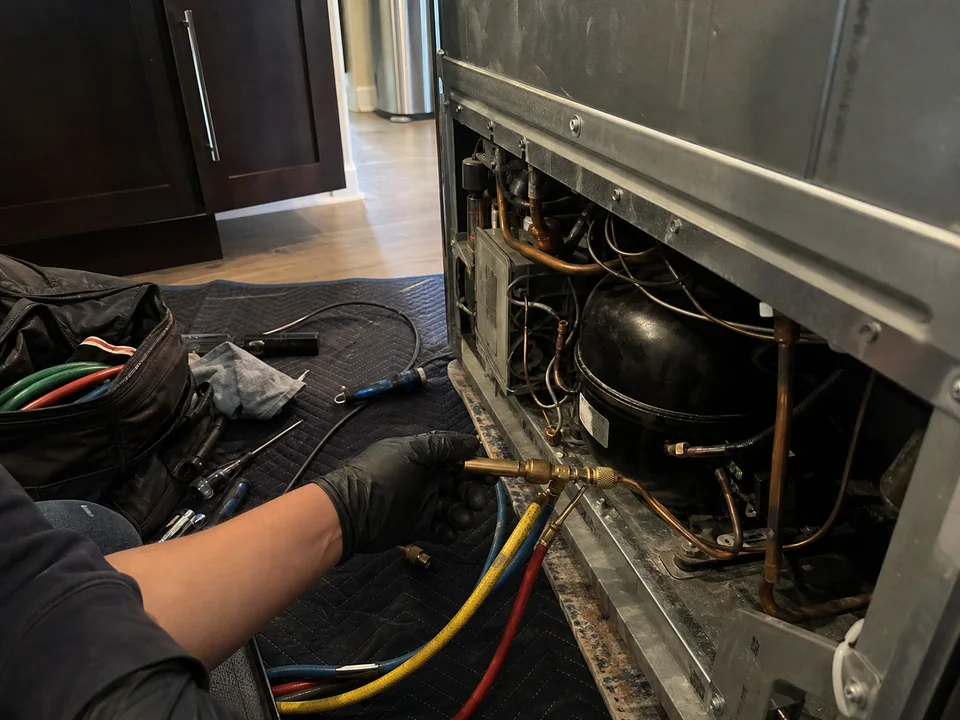
Sub-Zero repair in Alameda — straight answers
Who repairs Sub-Zero refrigerators in Alameda?
Alameda Sub-Zero Repair services built-in Sub-Zero refrigerators, freezers and wine units across Alameda (94501 and 94502), including Bay Farm Island. Book by phone at (510) 390-9712, Monday to Saturday 7am-7pm, or through our online booking page.
Call (510) 390-9712 → Book online →
Do you offer same-day Sub-Zero repair in Alameda?
Often yes, when the day's route across the bridge still has an opening and the likely part is on the van. We won't promise a same-day slot we can't keep — call (510) 390-9712 early with your model number and symptom, and we'll tell you honestly whether your Alameda address fits today's run.
Do you cover both Alameda ZIP codes and Bay Farm Island?
Yes. We work the whole Island — 94501 across the Gold Coast, East End, West End and Fernside, plus 94502 on Bay Farm Island over the bridge. Tell us your neighborhood when you call (510) 390-9712 so we plan access past Webster Street and bring the right serial-matched parts.
Start with the symptom, not the brochure
Sub-Zero refrigeration fails in specific, recognizable ways. Find the one that matches what your unit is doing, read what it usually means, and follow it to the page that explains the test and the likely part. Each is written for Alameda kitchens, where the marine climate changes how fast some of these show up.
Fresh-food warm, freezer still cold
Usually means: a stalled evaporator fan, a defrost fault, or one sealed system underperforming — not a dead refrigerator.
Don't keep loading the warm side with groceries to "test" it.
Not-cooling diagnostic → Ice / waterIce slow, jammed, or hollow cubes
Usually means: a clogged filter, kinked fill line, or a tired inlet valve starving the mold of water.
Don't force the ejector arm or chip jammed ice with metal.
Ice maker & water line → SealCondensation, frost line, sweating door
Usually means: a stiffened or torn gasket letting humid Bay air leak past the seal.
Don't run a space heater at the door to "dry it out."
Door gaskets & seals → WineWine column drifting several degrees
Usually means: a thermistor reading off, a stuck damper, or a sealed-system loss — confirmed with a logged temperature trace.
Don't trust the display alone; verify with an independent probe.
Wine storage temperature → Sealed systemBoth sides warm, compressor suspect
Usually means: a refrigerant or compressor issue that needs EPA-certified verification before any part is named.
Don't let anyone "add a can of gas" without a leak test.
Sealed system & compressor → AlarmDisplay alarm or service code
Usually means: a sensor, fan, or board fault — the code narrows it, measurement confirms it.
Don't replace the control board first; it's rarely the cause.
Error codes & alarms →What we actually look at
An ice maker that drops slow, hollow cubes almost never needs the module it sits in. The fix follows the water: a logged fill-volume test tells us whether the inlet valve, filter, or fill tube is the restriction. What we can't know before inspection is whether a marginal valve is failing electrically or just starved — that takes a live measurement on site, which is why we confirm before we quote a part.
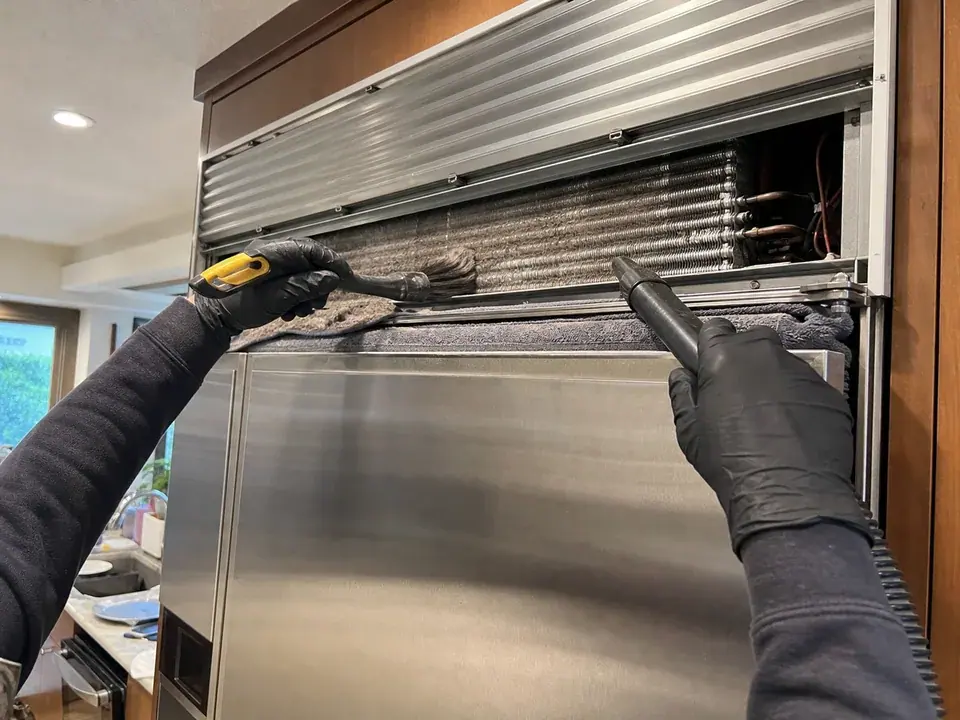
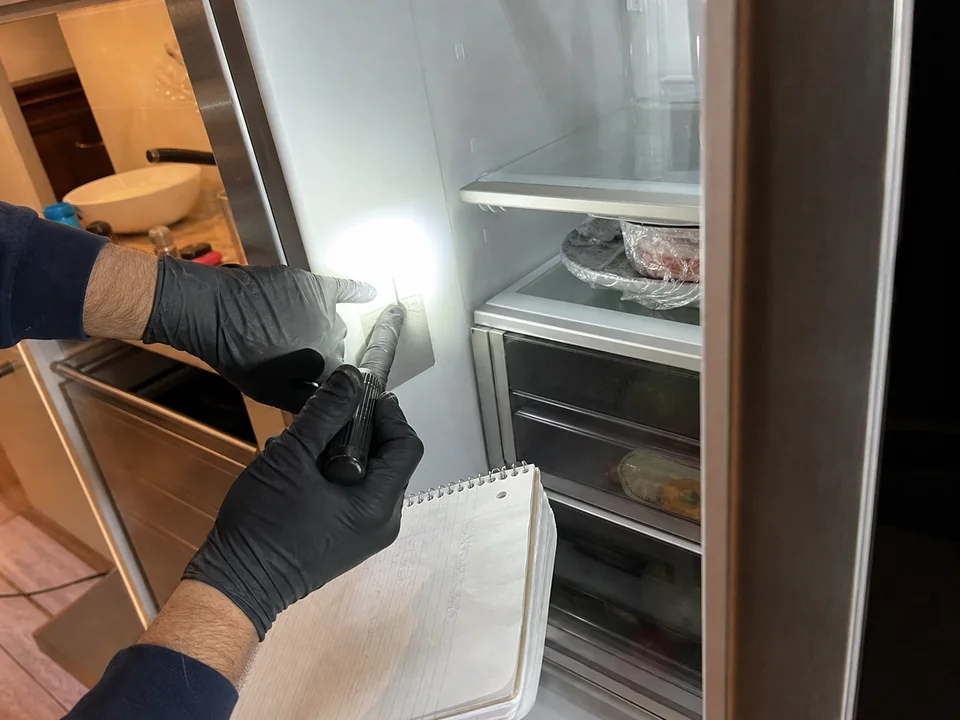
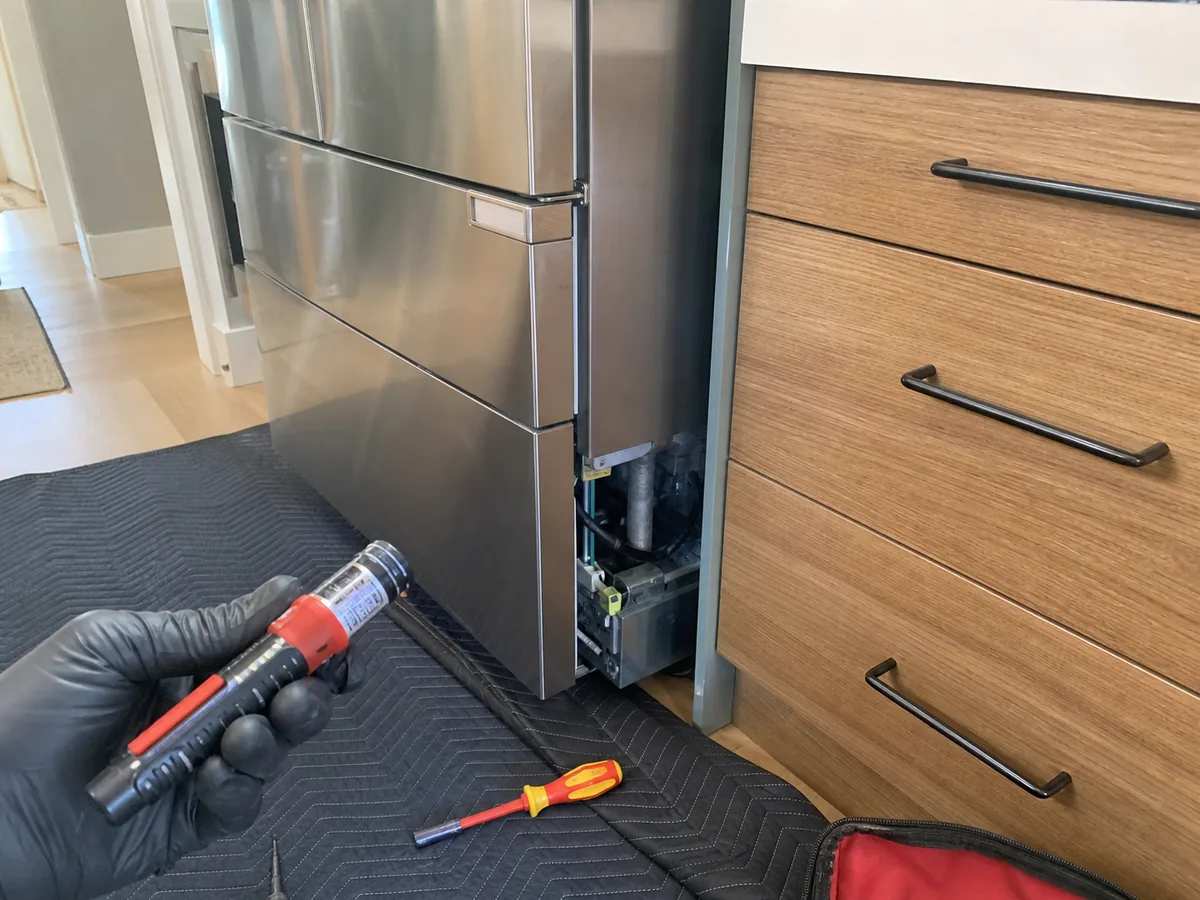
The order we work in
Intake by symptom
You describe what the unit is doing; we ask the few questions that separate a fan fault from a sealed-system fault.
Model & serial confirmation
A photo of the rating plate tells us the exact dual-refrigeration generation and which factory-authorized OEM parts match.
First test on site
Temperatures, airflow, and component readings — measured, logged, and compared to spec for that model.
Likely part, named honestly
We tell you the failed component and the one alternative we'd rule out first.
Written quote
The diagnostic fee, the part, and the labor, before any work begins.
Repair & verification
After the fix, we re-check temperature recovery and leave you the readings.
Have the model number? Let's check parts first.
Tell us the symptom and send a photo of the Sub-Zero rating plate. We'll confirm whether the likely part is in stock for an Alameda visit before you commit to an appointment.
Find the model & serial before you call
The single most useful thing you can do is photograph the rating plate. On built-in BI-series units it sits on the upper interior side wall; on columns it's near the upper hinge; on undercounter UC/UR units it's on an inner wall or the back panel. That model and serial tell us which evaporator fan, gasket profile, or control board your generation actually uses — so we can pre-stock the right part for the trip across the bridge rather than discovering the mismatch in your kitchen.
It matters more here than most places: Alameda's housing stock runs from 1920s East End bungalows to waterfront Bay Farm builds, and the same model badge can hide two different part revisions. The model & serial guide walks through every cabinet type with photos of where to look.
Parts and warranty, in plain terms
We fit factory-authorized Sub-Zero OEM parts matched to your serial, and the invoice names each one rather than billing a vague "repair." Here is how the counter side works.
Sealed-system components
Compressors, driers, and evaporator/condenser assemblies. Serial-matched, EPA-handled, never substituted with generic refrigeration parts.
Fans, gaskets & controls
Evaporator and condenser fan motors, magnetic door gaskets in the correct profile, thermistors and control boards by generation.
Ice & water
Inlet valves, fill tubes, filters and ice-maker assemblies — replaced only after a fill-volume test names the real restriction.
Workmanship terms
- Parts
- Factory-authorized Sub-Zero OEM
- Invoice
- Each part itemized
- Findings
- Readings left with you
- Labor
- Quoted before work
Exact warranty duration is set on the written estimate. We don't print "lifetime" language we can't stand behind.
What we won't claim
- No same-day promise unless the route really allows it.
- No replacement push when a clean repair will hold.
Cabinet-safe service
Pulling a built-in past custom millwork is its own skill. See how we protect the surround when a unit has to come out.
Where you are changes the repair
Alameda is small, but its kitchens are not uniform. The neighborhood often tells us as much about the likely fault and the access as the model number does.
Period homes, tight surrounds
Grand Victorians with built-ins tucked into original millwork — clearances are minimal, so condensers foul faster and pulls have to be careful.
1920s bungalows, retrofit kitchens
Older flats where water tubing snakes through cabinetry; ice and fill-line restrictions are common and access is the first problem to solve.
Newer builds, panel-ready columns
Across the bridge on Bay Farm, integrated column refrigerators dominate — gasket sweat and damper drift show up with the area's open, humid air.
Waterfront humidity
Close to the estuary, salt-laden marine air is hardest on seals and condenser coils; we plan gasket and corrosion checks accordingly.
What a Sub-Zero repair tends to cost in Alameda
Every visit opens with a flat diagnostic fee, credited toward the repair once you approve it. The table lists typical Alameda estimates by job; your written quote is set on site after the model and serial are read.
| Service / symptom | What's included | Price range | Timeframe |
|---|---|---|---|
| Diagnostic / service call | On-site measured diagnosis, model & serial confirmed, written findings (credited to the repair) | $115–$185 | Same visit |
| Condenser clean & airflow service | Coil clean, fan check, temperature recovery verified | $165–$295 | 1 visit |
| Door gasket & alignment | factory-authorized OEM magnetic gasket in the correct profile, door reveal reset | $215–$395 | 1 visit |
| Evaporator / condenser fan motor | factory-authorized OEM fan motor, airflow and temperature recovery confirmed | $365–$685 | 1 visit (part 2–5 days if not stocked) |
| Thermistor / temperature sensor | Sensor replaced, verified against a logged probe trace | $185–$345 | 1 visit |
| Ice maker / inlet valve | Fill-volume test, factory-authorized OEM inlet valve or ice-maker module | $245–$525 | 1–2 visits |
| Control board (generation-matched) | Board matched to your generation, service-mode reset | $485–$845 | 2–6 days (part order) |
| Sealed system / compressor (EPA) | Refrigerant recovery, leak/charge or compressor, post-repair recovery check | $1,750–$3,450 | 1–2 visits |
Typical Alameda estimates, not a quote. Sealed-system work is priced separately for refrigerant handling.
What determines the final price: your unit's generation and serial (which revision of fan, gasket, or board fits), whether the built-in must be eased out of period cabinetry, and whether the fault is a single component or a sealed-system question. Repair vs. replace shows when the math favors a new unit.
Repair or replace? The honest version
Repair usually wins when…
- The fault is a fan, gasket, thermistor, or board — not the sealed system.
- The cabinet is integrated into custom millwork that a new unit won't fit.
- The unit is under ~15 years and otherwise holding temperature.
Replacement deserves a look when…
- A failed compressor meets an aging cabinet and discontinued parts.
- Multiple systems are failing at once on a 20-plus-year unit.
- You're already remodeling the surround the built-in sits in.
Before you call: a 2-minute Sub-Zero self-check
A Sub-Zero holds the fresh-food compartment near 38°F and the freezer near 0°F. These five steps tell us whether it's an airflow issue you can ease or a fault that needs a visit. None of them open the sealed system.
Read both compartment temperatures
Put a thermometer in each compartment for 10 minutes. A fresh-food side above ~42°F while the freezer still holds points to one circuit or a fan, not a dead unit.
Check the condenser airflow
On built-ins the grille is up top. If the coil looks matted with dust or pet hair, blocked airflow is a common Alameda cause of slow warming.
Inspect the door gasket
Run a hand around the seal for cold leaks. A frost line or a sweating seam in our marine air usually means a swollen or stiffened gasket.
Photograph the rating plate
Model and serial decide which fan, gasket, or board fits — send the photo so the right factory-authorized OEM part rides on the van.
Note any alarm or service code
Write down the exact code on the display; it narrows the diagnosis before we arrive.
Sub-Zero questions from Alameda owners
What's a normal temperature for a Sub-Zero, and when is a warm fresh-food side an emergency?
A Sub-Zero holds the fresh-food compartment near 38°F and the freezer near 0°F. A fresh-food side drifting above about 42°F while the freezer still holds usually points to one of the two sealed systems or an evaporator fan — urgent for food, but rarely a dead unit. Move perishables, keep the doors closed, and call.
Does Alameda's salt air and fog really shorten the life of Sub-Zero parts?
Yes. The marine air off the estuary carries salt and steady humidity, which corrode condenser coils and swell door gaskets faster than inland conditions. In Alameda we see gasket sweat, frost lines, and fouled condensers earlier, so we build corrosion and seal checks into most visits — especially near the waterfront in Fernside and on the Gold Coast.
Our tap water is soft — why is our Sub-Zero ice slow or hollow?
Because EBMUD water serving Alameda (94501, 94502) is soft, scale buildup is rarely the cause here. Slow or hollow Sub-Zero ice is far more often a failing water inlet valve, a clogged filter, or a kinked fill line. A quick fill-volume test names the real restriction before any part is replaced. Typical fix runs $245–$525.
Will pulling our built-in out of original Alameda cabinetry damage the millwork?
It doesn't have to. In Gold Coast and Park Street homes from the early 1900s, built-ins sit in tight period casework. We release the panel brackets, lay floor and jamb protection, and ease the unit out on glides rather than dragging it. A careful pull and reseat adds roughly $120–$295 to the job.
Do you cover both Alameda ZIP codes and Bay Farm Island?
Yes — we serve the whole Island, 94501 and 94502, including the Gold Coast, East End, West End, Fernside, and Bay Farm Island across the bridge. Neighboring Oakland and San Leandro are covered routing-permitting. Telling us your neighborhood when you call lets us plan access and bring the right parts.
Do you only work on Sub-Zero, or other refrigerator brands too?
We're a cold-side Sub-Zero specialist — built-in and column refrigeration only. Focusing on one brand means we diagnose by your model and serial, carry the right factory-authorized OEM fans, gaskets, and boards by generation, and don't guess across a dozen brands. For appliances we don't service, we'll point you to the right specialist.
Service areas near you
Looking for Sub-Zero repair near you? We cover all of Alameda — the Gold Coast, the East End, Bay Farm Island, Fernside, and the Park Street district — across ZIPs 94501 and 94502, and we dispatch nearby to Oakland and San Leandro for built-in Sub-Zero work.
The office on Marina Village
Scheduling and mail run through 1101 Marina Village Parkway, Suite 201, Alameda, CA 94501 — on the Island's north shore, a short hop from the Webster Street tube. The repairs themselves happen in your kitchen, by appointment; there is no walk-in counter and nowhere to drop an appliance off.
Alameda · Sub-Zero owners
What Alameda customers say
★ 4.9 average over 326 reviews across our wider Bay Area service network.
Fresh-food side kept creeping warm while the freezer held fine. They read it off the model number over the phone, arrived with the right fan, and had it holding temperature the same afternoon.
Honest from the first call. They talked me out of replacing a built-in that just needed the condenser cleaned and a fan motor. Itemized invoice, factory-authorized Sub-Zero parts.
Careful pulling our BI-36 out of tight cabinetry, not a scratch. They left the temperature readings with us so we knew exactly what was fixed.