Wine storage guide · 6 min read
Why a Sub-Zero wine column drifts warm on the Alameda waterfront
A Sub-Zero wine column that creeps above 55°F in Alameda is usually airflow, a tired dual-zone sensor, or a seal aged by estuary humidity — not a dead compressor. What's really happening and how it's fixed.
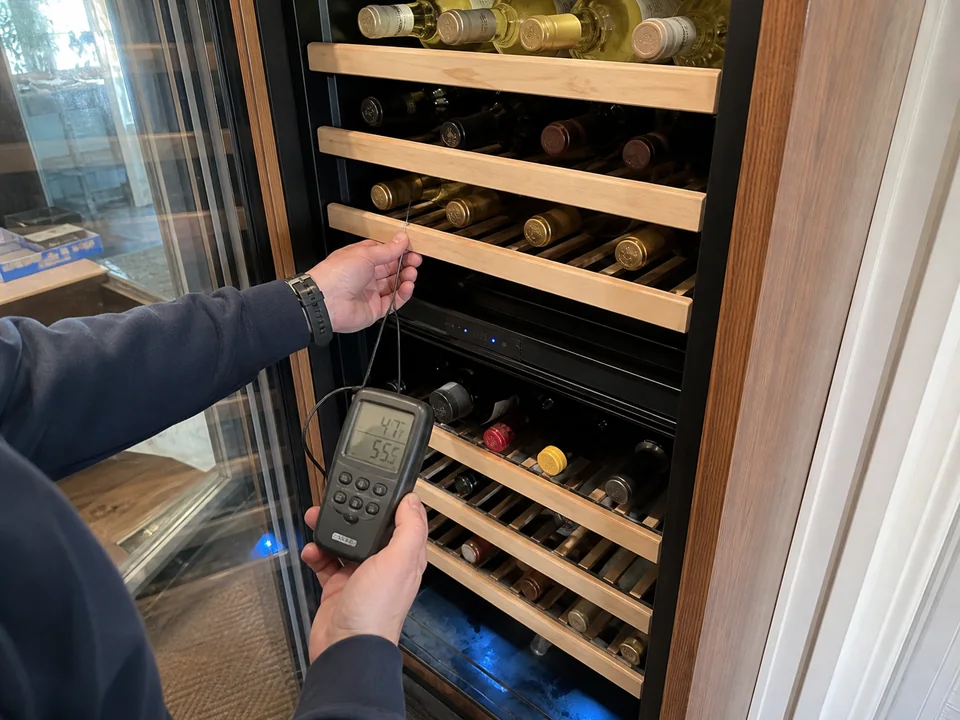
A Sub-Zero wine column is a different animal from the kitchen refrigerator. It is built to hold a narrow band — roughly the low-50s for reds, the mid-40s for whites — and to hold it steadily, because wine reacts to swing far more than to any single temperature. So when an Island owner calls us, the complaint is rarely "it's broken." It's "the top zone reads four degrees warm" or "the glass is sweating and I can't tell if the cork's at risk."
On Alameda, the surrounding water shapes which of those small faults shows up first. Estuary humidity and steady marine air work on the seals and the condenser the same way they do on a built-in fridge — just with less margin for error, because a wine column is trying to defend a tighter setpoint.
Dual-zone drift: the sensor and the airflow, not the gas
Most Sub-Zero wine units run two independently controlled zones from a single sealed system, splitting cold air between an upper and lower compartment with a damper and a fan. When one zone drifts warm while the other holds, the sealed system is usually fine — the problem is the thermistor reading that zone or the airflow feeding it. A sensor that has drifted out of calibration tells the control board the zone is colder than it really is, so the board simply stops cooling it. We read the actual zone temperatures against what the display claims; a gap between the two points straight at the sensor. A real refrigerant fault, by contrast, makes both zones struggle together and the compressor run nonstop — a different symptom entirely, and the one repair-vs-replace decision actually turns on.
Airflow, the condenser, and the bottles that block it
A wine column sheds heat through a condenser coil behind the lower grille, and on the Island that coil collects a fine, faintly salty dust faster than it would inland. A loaded coil makes the compressor run long and warm and is one of the most common reasons a column quietly creeps above 55°F. Inside, airflow matters just as much: a fully packed Gold Coast cellar where bottles crowd the rear vents can starve the evaporator fan's path, leaving the top shelves warm while the bottom stays right. Clearing the coil and leaving the internal vents unblocked fixes more warm-drift complaints than any part swap — which is why we measure airflow before we ever reach for a component.
The seal, the UV glass, and the cost of vibration
The glass door is where Alameda's climate shows up first. The gasket and the UV-tinted seal age faster in salt-laden, humid air than they would in Livermore or Pleasanton, and a door that no longer pulls flush lets warm estuary air leak in — you'll see it as condensation beading on the glass and a top zone that won't settle. A gasket is a bounded, genuine-part repair and almost always worth doing. The quieter issue is vibration: a worn fan bearing or a compressor mount that has loosened over years transmits a faint tremor up through the racks, and constant micro-vibration disturbs the sediment in older bottles. If your column has started to hum where it used to be silent, that's worth a look before it ages your collection. When a unit is otherwise sound, all of this is fixable; we reserve the replace conversation for a failed sealed system on an older column where the refrigerant repair approaches the cost of the cabinet itself — and we'll tell you plainly which side of that line you're on.
Questions & answers
My Sub-Zero wine column's top zone reads warm but the bottom is fine — is the compressor dying?
Almost never. When only one zone drifts, the sealed system is usually healthy and the culprit is a drifted dual-zone sensor or blocked airflow to that compartment. A failing compressor makes both zones struggle and runs nonstop. We measure actual zone temperatures against the display to tell the two apart before quoting anything.
Does Alameda's waterfront climate really affect a wine cooler?
Yes. Estuary humidity and marine salt air age the door gasket and UV-glass seal faster and load the condenser coil sooner than inland conditions, and a wine column defends a tighter setpoint than a fridge — so it shows those effects first. An annual condenser clean and seal check pays off sooner here than away from the water.
More Alameda guides
How to Verify a Sub-Zero Repair Company in Alameda: License, Insurance, and the Island Test
Three checks before you book Sub-Zero repair in Alameda: the free state registration lookup, a real insurance certificate, and the island logistics test.
Read the guide → Sub-Zero freezer not freezing · 4 minSub-Zero Freezer Not Freezing While the Fridge Stays Cold: An Alameda Diagnostic
Why a Sub-Zero freezer drifts warm while the fridge stays cold in Alameda: sealed-system vs defrost vs salt-fouled condenser, plus the $89 diagnostic.
Read the guide → Energy Use and Running Cost · 7 minHow Much Does a Sub-Zero Cost to Run? Energy Use in Alameda Homes
What a Sub-Zero really costs to run in Alameda: typical kWh per day, why salt air raises the draw, and which repairs cut it. $89 visit, credited to the repair.
Read the guide →Rather leave it to a specialist?
Have the failing compartment and the model number ready, and you will get a real first opinion — not a sales pitch.